

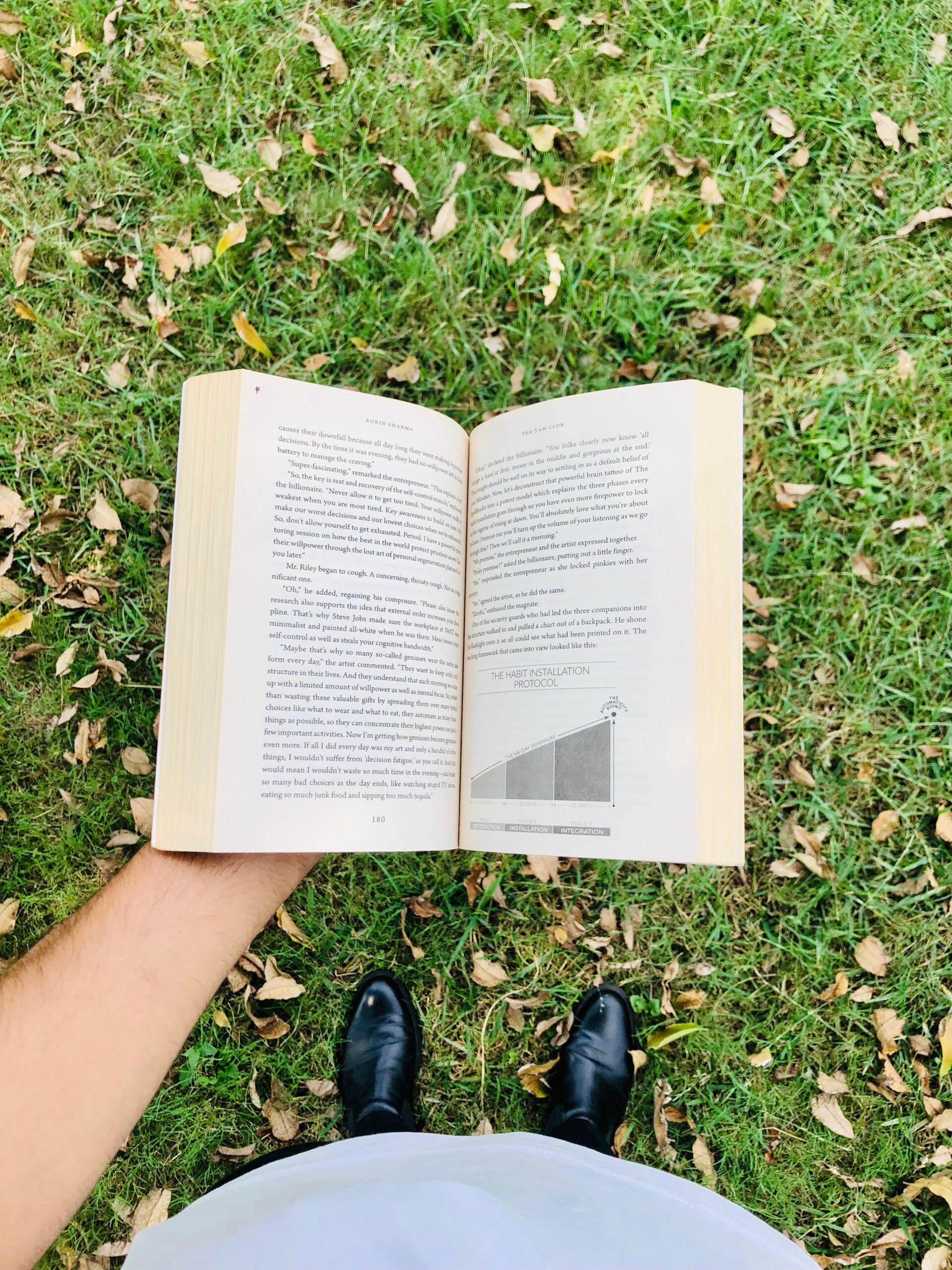
Book readers are not normal and perhaps that is the greatest compliment anyone could ever give them.
The world has never been changed by people who simply accepted it as it was. It has always been changed by those who questioned, challenged, imagined something beyond it—and behind every such mind, more often than not, stood a bookshelf. We, the people who read, do not merely collect books; we collect personas, perspectives, doubts, revolutions, heartbreaks, civilizations and lives we never lived. However, somewhere between turning pages and underlining sentences, something strange happens within. We stop reading books, and the books quietly begin reading us. We don’t observe the world the way everyone else around us does. We don’t enter into a fray carrying only our bodies. Rather, we walk in with hundreds of minds inside us. Every book we have ever loved whispers in our ears and every page of it we have understood lives quietly within us. A person who has truly fallen in love with books can never return to being an ordinary one.
As Frederick Douglass once said:
“Once you learn to read, you will be forever free.”
Frederick Douglass
Our freedom does not begin when chains of ignorance are broken. It begins when our minds decide not to wear those shackles anymore. A genuine reader could always be vividly recognized. Most of the time, they are the quietest, most innocent person in the room but their silence and nonchalant behavior should not be mistaken for emptiness. In fact, their silence is crowded with thoughtful questions, memories, arguments, dreams, philosophies and conversations with people who died centuries ago. In a place, where everyone tries to gain the upper hand, where everyone else rushes to speak, they will still hold themselves and listen. This rationale and humanistic behavior is driven by books that not only teach knowledge but tolerance and a sense of mutual understanding as well.
Have you ever watched someone reading their favorite book—a book they truly love. The moment they start reading it, the world disappears, their smart phones remain untouched and time itself seems embarrassed to interrupt this inexplicable bond. There is something almost sacred about opening a new book. The smell of fresh pages, the slight roughness beneath fingertips, the quiet sound of turning pages while still contemplating the previous ones. These small rituals are inevitable for true book readers, yet they awaken emotions that are extremely hard to put into words. It feels less like opening paper and more like visiting a newly discovered universe. People often ask how many books I’ve read. I’ve started wondering whether the better question is how many books have truly read me.
Jorge Luis Borges once confessed:
“I have always imagined that Paradise will be a kind of library.”
Jorge Luis Borges
He wasn’t exaggerating at all because inside books, we experience the kind of lives we never thought we could confront at any point in our lives. In it, we force ourselves to suffer from the tragedies without being physically wounded. We travel rigorously without taking a single step and still somehow come back heavier than we left. A true reader falls in love with people who never existed and mourns characters whose funerals never really happened. That is not normal. Books stretch the boundaries of empathy and humbleness and they don’t merely occupy a shelf; they quietly occupy the person reading them. They alter the trajectory in which one judges, questions, loves and even suffers. A genuine reader doesn’t collect books—they collect new ways of seeing the world.
After reading Dostoevsky’s Crime and Punishment, we tend to become slower to judge people. Raskolnikov’s guilt reminds us that we, human beings, are rarely as simple as heroes and villains. We start to look beyond the actions of individuals and wonder what silent battles a person could be fighting within. Then Nietzsche’s Zarathustra arrives like a fierce storm and forces us to confront the comfort we once called happiness. His idea of the Last Man makes mediocrity feel to us more frightening than failure, urging masses not merely to exist, but to constantly overcome themselves. Dawkins’ mercilessexamination of religion in The God Delusion teaches us something far greater than agreement or disagreement. It teaches intellectual honesty and the utmost courage to be skeptical about inherited beliefs, to seek evidence before blindly following and to comprehend that curiosity is often more valuable than certainty.
With Yuval Noah Harari’s Sapiens and Nexus, our history and the present suddenly become connected and we begin to realise that civilizations are built on shared stories, while the modern world is increasingly shaped by information. From that moment on, it’s become impossible to believe every narrative just because it is popular with the masses. Khaled Hosseini’s The Kite Runner teaches empathy in a way facts never could. It leaves us carrying another person’s guilt, friendship and longing for redemption while proving that some fictional characters understand the human heart better than many real people ever will. And then Elif Shafak’s The Forty Rules of Love gently makes us fathom that love is not possession rather a way towards transformation. Through Rumi and Shams, we came to know that the greatest revolutions scarcely happen in kingdoms or parliaments—they happen quietly within a single human soul.
And maybe that’s the core reason readers seem different relative to non-readers. Every remarkable book we read leaves behind a small piece of itself till the day we come to realize we are no longer witnessing the world through our own eyes alone, but through the profound wisdom, pain, courage and vast imagination of everyone we have ever read.
As George R. R. Martin wrote:
“A reader lives a thousand lives before he dies. The man who never reads lives only one.”
George R. R. Martin
That is exactly the role that books play. They enrich our very existence and make this single lifetime feel beautifully insufficient.
But let us not romanticize readers too much. Book readers have flaws too. Most of the time, they overthink and disappear into ideas while neglecting reality, they become impatient with shallow conversations, they mistake knowledge for wisdom and sometimes they isolate themselves so much that, for them, loneliness quietly becomes their closest companion. Even after years of reading, I still find myself falling short of the very ideals I admire. There are moments when my temper outruns my wisdom, when my ego speaks louder than the voices of the authors I cherish. Afterwards, I don’t merely regret my actions—I wonder how I could have acted that way after spending so much of my life among books. Then I remember that literature does not manufacture virtue overnight. It simply refuses to let us remain comfortably unaware of our shortcomings. Perhaps overcoming oneself is not a destination reached after reading enough books, but a lifelong conversation between the person we are and the person every great book quietly asks us to become.Yet there is something remarkably exceptional about readers. When they fail, they usually return to themselves. When anger overwhelms them, they often ask, “Was I wrong?” before asking, “Who took a shot at my ego?” Even during intense conflict, in moments of physical confrontation—a thoughtful reader gradually realizes that winning an argument or a fight is not equivalent to winning in life. Books teach us that the strongest response is often discipline rather than impulse to respond. It pushes the readers to let themselves know that reflection matters the most rather than revenge. It’s not because book readers are weak or unable to play dirty tactics with their counterparts but because they understand the price of becoming what they hate.
Marcus Tullius Cicero reminded us:
“A room without books is like a body without a soul.”
Marcus Tullius Cicero
And perhaps a life without the inclusion of books—our source of reflection—slowly becomes the same.
There is a beautiful poem by Emily Dickinson:
There is no Frigate like a Book
To take us Lands away,
Nor any Coursers like a Page
Of Prancing Poetry
These are four simple lines yet they contain an entire ocean in them.
Book readers have no thought of escaping reality. In fact, they are preparing themselves to face it even better and with discernment to carry it. They become silent wanderers in a world that is addicted to chaos. They eventually learn that not every opinion deserves a response, not every patronizing behavior deserves revenge and not all people deserve to be followed. In our age where everyone wants attention, encouragement and recognition, readers quietly chase the golden path of understanding — the thing that’s infinitely rarer in the contemporary world.
If you have recently made books your companions, don’t stop at reading alone. Read slowly, underline the ideas that disturb you or force you to overthink, write your thoughts in the margins, question the author, disagree respectfully, keep a journal and learn to read people as carefully as you read pages. You should allow every great book to change one habit, one belief or one weakness within you while keeping in mind, the knowledge that doesn’t transform your behavior is merely a decoration. The greatest readers are not those who finish the most books but those whose lives have become the evidence of what they read. And that’s why book readers are never truly alone. A library is the only place where you can deeply analyze the hidden morals in Dostoevsky’s novels, disagree or rejoice over Nietzsche’s courageous and uncensored literature, marvel at your past and future with Harari, cry with Hosseini, question yourself with Dawkins, fall in love with Mavlana Rumi and still somehow find the strength to make your way back home before sunset.
If you already have books in your life, don’t simply count how many you’ve finished so far. Instead, ask yourself how many have finished shaping you and if you haven’t yet discovered the quiet companionship of books, open just one—not to escape the world but to understand it and perhaps to understand yourself. Because in the end, every page you turn is also turning something within you. The actual, and the finest readers are not remembered for the number of books they owned, but for the kind of human beings those books helped them become.
Don’t ever stop reading. The next page might introduce you to yourself.
And if you’ve never been a reader, perhaps your favourite book is still waiting to find you.