
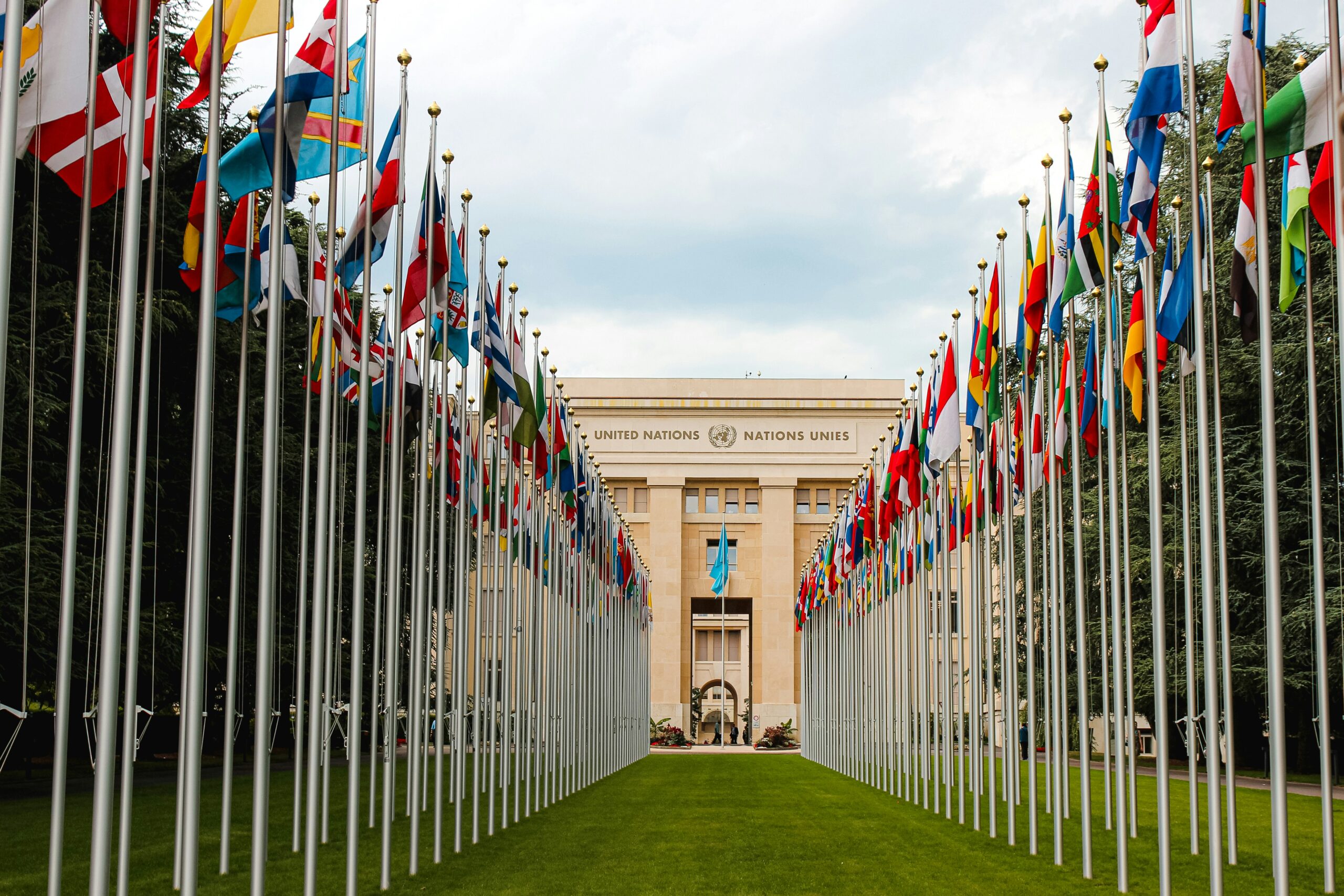

The catastrophic dust of the Second World War had to settle and the world witnessed another guarantor of peace and prosperity, a modified and more effective one, after the devastating failure of the League of Nations — this time under the title of the United Nations. The principal proponents of the idea of the United Nations were the then US president Franklin D. Roosevelt and the then UK premier Winston Churchill, ironically who both were major contributors to the Second World War, assumed the responsibility of introducing a new international order based on fraternity, calmness, sharp diplomacy, and cooperation among nations. Subsequently, in 1945, representatives from 50 countries met at the San Francisco Conference and drafted and unanimously signed a new international policy agreement, later known as the UN Charter. Consequently, on October 24, 1945, the UN officially came into existence.
Since this time, various wars, border clashes, massacres and genocides, and frequent exchanges of undiplomatic and provocative rhetoric have been observed among the nations, and that too among the signatories of the UN charter. The list of these states and anecdotes may complete a full circuit around the equator and continue.
The Indo-Pak war of 1947, 1965, and 1971, the Arab-Israeli war of 1948, the Vietnam war, the Iran-Iraq war from 1980 to 1988, the Russia-Ukraine war, and the recent US-Israeli confrontation with Iran, apparently mediated by Pakistan — all give an outlook that the UN may have been established on paper, but its practicality has remained questionable since then.
Being a realist, my approach to analyzing this whole historico-international situation will also be one of realism. I hope I shall not be offending my readers when I say that these wars which have happened even after the establishment of the UN were inevitable, and that International law does not act on morality or the famously propounded principle of shared responsibility towards establishing a peaceful international order, rather, it acts on the philosophy of human nature and, more broadly, on the power-centric international order. To understand this, we shall use the analogy of lion. In a jungle, a lion always quests for a deer, a weaker creature. However much meat you put before a lion, it will still be worried to find its prey. This way of the lion’s action cannot be and ought not to be blamed, since it is its intrinsic nature. The lion is naturally wired to go after weaker animals and see them as its prey. Exactly like this wild colony, the international community plays in the same way, with only the players being different. The former has animals and the latter, humans.
Even hundreds of years before the birth of the United Nations, world history has witnessed a huge stockpile of wars and conflicts among nations, armies, and states, with the mighty one holding the cup of triumph. Be it then the Islamic golden age expeditions, the Roman Empire’s number of sieges of different regions, or the Napoleonic conquests — all reinforce the impression that might ultimately prevail and remain a justifiable way to overcome all impediments.
Nonetheless, critics might argue that the United Nations has still prevented another world war and therefore cannot entirely be labelled as a failure. Technically, this assumption holds a conceptual category error. Although institutions such as the International Court of Justice, the UN peacekeeping missions, and various humanitarian agencies have indeed contributed towards conflict management, and diplomatic engagement among hostile nations. However, one must not assess realism merely based on the existence of such institutions but rather on the extent of their enforceability against powerful actors. The double-faceted schemes of the United Nations appear lucid when a weak nation violating international law is swiftly condemned, sanctioned, and isolated, whereas a powerful state often manages to bypass international accountability usually at the behest of military dominance or strategic alliances. For instance, if Iran starts advancing its nuclear program, or Russia invades Ukraine the United States of America along with other western nations seems visibly unsettled, while, on the other hand the USA drops the devastating atomic bombings on Japan and one sidedly initiates the war on Vietnam, flagrantly ignoring the fundamental principles of humanity, and does not even get genuine condemnation from international community, let alone the sanctions or diplomatic isolation. This selective application of international law remains one of the greatest contradictions within the modern international order. Additionally, the veto power itself symbolizes this imbalance where certain nations enjoy privileges above the very principles of equality and justice upon which the UN was supposedly founded. A true international community pledged to follow universal moral values such as equality, justice, peace, and fairness in their dealings cannot afford its conscience to bear such a colossal burden of moral inconsistency where power and dominance shape the international system and not the purported moral codes. Therefore, the question is not whether international law exists, but whether it exists equally for all nations.
Now comes the real question: what should the world do? Should every country simply initiate its work on weapons production at an exponentially large scale? Should weapons of mass destruction be justified under this principle of natural law, and should countries be allowed and encouraged to generate weapons of mass destruction at unprecedented levels only under the pretext of securing their territorial integrity? The answer lies not in an objective proclamation but in subjective grounds of what the world collectively wants to achieve. Is it the law of the jungle to live in a chaotic environment under the looming threat of being engulfed by the mightier nation or on more reasoned and sane paths of fraternity and collective growth of humanity in every sphere of life? If the world opts for the former, then with great distress, it must be penned that producing large scale and destructive equipments seems to be the only way in this regard, and if the world chooses the latter path of living on principles, which is the course that draws the line between man and the wild, then the world certainly should take active steps to go beyond the scripted texts of international law and make genuinely enforceable international standards.
To achieve this aim, every country of the world regardless of its history, economic or military might, needs to surrender certain rights — such as its offensive and lethal weaponry— under an unbiased and entirely impartial international institution and in return seek a peaceful international order. This holds quite a resemblance with Rousseau’s social contract theory under which individuals are required to surrender certain rights and in return the government pledges and guarantees them security, peace, and a just living space. The international world needs no new idea or theory but the expansion and adaptation of an already established social contract theory which may be named as the “international contract theory”. Now this envisioned international institution must be established by every state of the world equally, not on the model of the UN which gives exceptions to powerful nations such as bestowing them the power of veto. Of course, this theory is an ideal and utopian scenario but if the world truly wants to achieve the collective progress of mankind, it serves as the bare minimum. On the contrary, if the powerful nations are only interested in keeping their hegemonic identities intact, then this theory shall prove an impractical theoretical framework that no country bothers to care about.
However, if at all this system gets its place in the international community and a world order based on true principles of equality and justice is established by giving up weapons and setting aside expeditionary ambitions by powerful countries, one realm remains unclear: the economic wars. Let us just be honest here, modern warfare is heavily influenced by economy and capital. A country may halt its exports of crucial commodities to gain leverage against its opponent, leaving the uninvolved countries at the brink of economic crisis such as the current Iranian blockade of the Hormuz strait that leaves almost all the economies of the world terrified and vulnerable to economic instability. For the restraint of such international economic exploitation, world trade must be initiated against gold or natural reserves, and not be concentrated in a single currency such as the dollar or any other one. An interdependent economic world where all the economies of the world are contingent on each other, thereby weakening the monopolistic economic dominance. Only then can one anticipate the true equality and a just equilibrium between the powerful and the frail.
In a nutshell, the core focus of this piece remained on the fact that the international community is nothing less than a morally numb international order where powerful states coerce and eventually end up dominating weaker states. International institutions like the UN, have always been the puppets of powerful nations, where their impartiality has always remained under suspicion. Nonetheless, if the collective aim of the world is the betterment of humanity, then the ideological groundwork of Rousseau serves as a compelling reason to rely on. However, if the world wants otherwise, then it should be better left pursuing arms and military race and wait for the ultimate doomsday this vice could lead us to.